
Second Day of the Iraqi Medical Congress (IQMC 2025) Closes with Wide Scientific Engagement
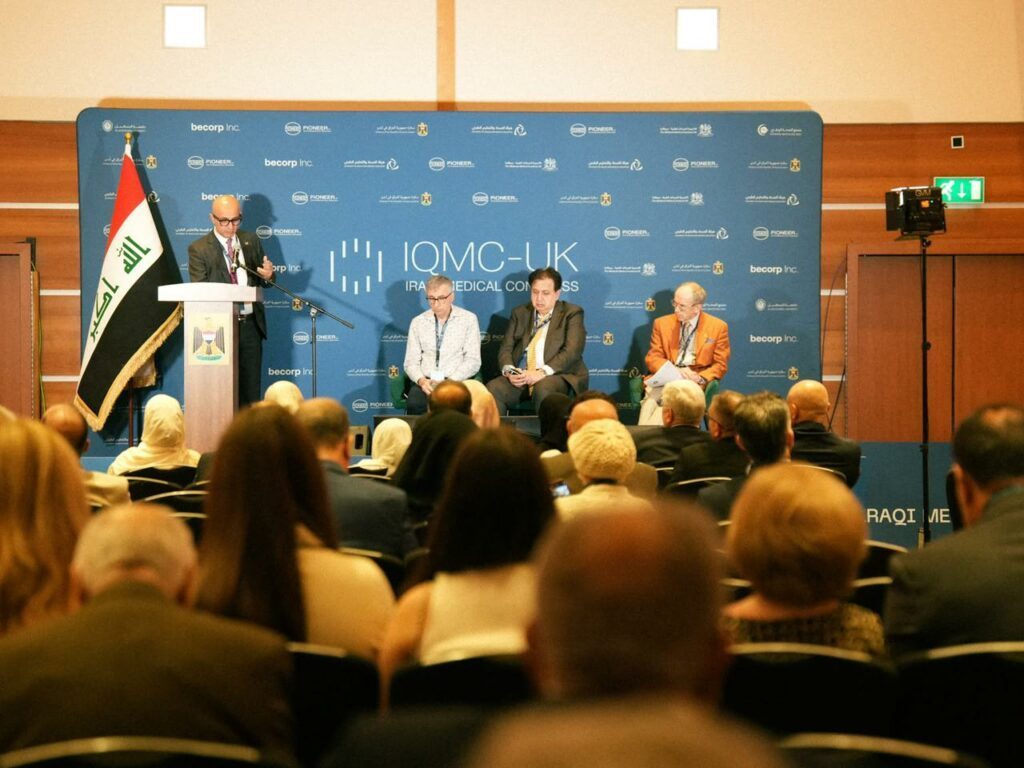
The First Iraqi Medical Congress (IQMC 2025) continued its activities into the second day on Sunday 15th June 2025 in London, attracting a distinguished scientific audience and wide array of participation of Iraqi doctors and academics from both within Iraq and abroad, alongside representatives of international health institutions.
Highlights From Day Two
The day featured a series of in-depth scientific sessions and expert led workshops addressing key health challenges and future opportunities in Iraq. Topics included:
- ‘Antimicrobial Resistance – The Silent Threat: Prof. Waleed al-Wali who examined the consequences of antibiotic overuse on treatment efficacy, recommending the establishment of a national surveillance and public education system.
- ‘Made in Iraq – Paving the Way for Local Bio-similar Manufacturing’: Dr Mayada al-Khaqani, who emphasised the importance of developing bio-similars within Iraq, discussing challenges around public and provider trust. She stressed that education and training are vital to advancing this agenda and affirmed that Iraq possesses the technical and human resources to shift from import dependency to local production.
- ‘Genomic and Precision Medicine in Diagnosis and Therapy’: Dr Nibras al-Khayyat (Germany) highlighted how genetic medicine can enhance diagnostic accuracy and enable more targeted treatments.
- ‘Mental Health in Post-Conflict Environments’: Dr Fatima al-Kubaisi, who called for integrating mental health services into Iraq’s primary care system.
- ‘Telemedicine – Expanding Access and Improving Service’: Dr Sarah Abdul Ameer.
- ‘Clinical Documentation and Quality of Care’: Dr Qais al-Badr.
- ‘Research Ethics in Complex Environments’: Prof. Hassan al-Noori.
- ‘Therapeutic Nutrition and Its Role in Managing Chronic Diseases’: Dr Amal Hussein.
- ‘The Present and Future of Organ Transplantation in Iraq’: Dr Nasser al-Karawi.
- ‘Towards a Decentralised Health System – Challenges and Opportunities’: Dr Emad Shehab.
- ‘Mental Health in Iraqi Medical Curricula’: Dr Zainab Talib.
- ‘Driving Innovation in the Health Sector Through Medical Incubators’: Dr Nizar al-Baghdadi.



Initiatives and Workshops
- National initiative to combat antimicrobial resistance, in partnership with the World Health Organization (WHO).
- A preliminary showcasing of the ‘Iraq Digital Health’ platform, designed to integrate national health data.
- Workshop to develop a national protocol for chronic disease medications involving researchers from both Iraq and the diaspora.
Key Recommendations
The day concluded with a set of strategic recommendations to support healthcare reform in Iraq, including:
- Development of a comprehensive national strategy to combat antimicrobial resistance.
- Support the local production of bio-similars, ensuring quality oversight by the health authorities.
- Promoting trust in locally produced medicines via continuous medical education and training.
- Inclusion of mental health within primary healthcare services as well as medical education curricula.
- Expansion of telemedicine infrastructure and services to improve access to care.
- Aligning scientific research with national health challenges, backed by sustainable funding mechanisms.
Core Messages
Several key messages emerged throughout the sessions and workshops of the day, including:
- Antimicrobial resistance must be addressed with responsibility and strategic planning.
- Iraq is capable of production, not just importation.
- Education and training are pillars of trust in the healthcare system.
- Mental health is a necessity, not a luxury.
- Solutions ought to emerge from within and be built via cooperation.